
Introduction
The demand for energy storage has never been greater. From powering electric vehicles (EVs) to stabilizing renewable energy grids and supporting mobile technologies, batteries sit at the heart of the global shift toward electrification and sustainability. As adoption accelerates, a new business model – Battery-as-a-Service (BaaS) – is gaining traction. Instead of owning batteries outright, customers can subscribe, lease, or swap them, just as they might with software or mobility services.
Definition
Battery as a Service (BaaS) is a business model in which customers lease or subscribe to batteries, rather than purchasing them outright, to power electric vehicles or energy storage systems. It allows users to swap or upgrade batteries when needed, reducing upfront costs, minimizing concerns about battery degradation, and ensuring access to the latest technology, while providers handle maintenance, charging, and lifecycle management.
What is Battery-as-a-Service (BaaS)?
Battery-as-a-Service refers to a model where consumers or businesses pay for access to battery capacity, rather than owning the physical battery outright. The approach is flexible and scalable, and can take several forms:
- Subscription-based access: Customers pay monthly fees for energy storage capacity, similar to how cloud storage works.
- Battery swapping: Common in EV markets, where depleted batteries are exchanged for fully charged ones.
- Leasing models: Companies rent batteries for a period, avoiding high upfront costs and transferring maintenance responsibility to the provider.
This model solves critical pain points such as high capital costs, unpredictable performance degradation, and the complexity of battery management. AI plays a central role in making these services reliable and cost-effective.
Why AI is Essential for BaaS
Batteries are complex electrochemical systems. Their performance depends on numerous factors – temperature, charge/discharge cycles, load conditions, and even micro-level chemical reactions. Without intelligent monitoring, predicting failures or optimizing performance becomes nearly impossible.
AI offers solutions through:
- Predictive maintenance: Machine learning models can forecast when a battery is likely to fail or degrade, allowing providers to replace or service it before customers experience downtime.
- Lifecycle optimization: AI algorithms can adjust charging/discharging patterns to extend battery life.
- Demand forecasting: Predicting customer energy needs helps providers allocate resources efficiently.
- Real-time monitoring: IoT sensors combined with AI allow continuous tracking of battery health and performance at scale.
This intelligence transforms BaaS from a logistical challenge into a high-performance, customer-friendly service.
Applications of AI-Powered BaaS
Electric Vehicles (EVs):
One of the most visible applications of BaaS is in the EV sector. Battery ownership is a major barrier for EV adoption due to high costs and concerns over lifespan. AI-enabled BaaS solves these issues by:
- Offering battery swapping stations, where AI manages inventory, charging speed, and distribution.
- Using predictive models to monitor degradation, ensuring drivers always have access to reliable batteries.
- Helping manufacturers refine battery chemistries by analyzing millions of performance data points.
Companies like NIO in China are pioneering this model, offering customers the ability to swap depleted EV batteries in just a few minutes – powered by AI-driven logistics and demand prediction.
Renewable Energy Storage:
Wind and solar power are intermittent. Energy storage systems are critical for stabilizing grids, but batteries need to be managed intelligently to maximize return on investment. AI supports this by:
- Predicting renewable generation patterns (e.g., sunny or windy hours).
- Balancing charging and discharging to reduce wear and tear.
- Enabling energy trading, where excess stored power can be sold back to the grid at peak times.
For renewable-heavy regions, AI-driven BaaS ensures that stored energy is available when it’s most valuable.
Consumer Electronics:
For smaller-scale applications, BaaS can apply to smartphones, laptops, and IoT devices. Instead of owning a fixed battery, users could subscribe to a service that guarantees optimal performance. AI would monitor usage patterns, charging behaviors, and provide recommendations or replacements before issues arise.
Industrial and Commercial Use:
Warehouses, manufacturing plants, and data centers rely on uninterrupted power. AI-powered BaaS can predict peak demand, optimize backup systems, and manage fleets of batteries to ensure seamless operations. By outsourcing battery management, enterprises can focus on core operations while enjoying reliable energy.
Key Benefits of AI-Driven BaaS
- Lower Costs for Users
Customers avoid high upfront costs of battery ownership. AI further reduces operational costs by minimizing unnecessary maintenance and extending lifespan. - Extended Battery Life
Intelligent charging cycles and predictive models reduce stress on batteries, ensuring they last longer. - Enhanced Reliability
With real-time monitoring, customers get consistent access to healthy batteries, whether for vehicles, homes, or businesses. - Sustainability Gains
Efficient battery usage reduces waste and improves recycling outcomes. AI can even predict the best time to retire or repurpose a battery, enabling circular economy models. - Scalability for Providers
AI helps service providers manage thousands (or millions) of batteries simultaneously, optimizing logistics and maximizing asset utilization.
Challenges and Considerations
While the synergy between AI and BaaS is powerful, challenges remain:
- Data Privacy & Security: With constant monitoring, providers must ensure user data is secure.
- Standardization: Different manufacturers use varying battery chemistries and formats, complicating AI training models.
- Infrastructure Investment: BaaS networks – especially swapping stations – require significant upfront capital.
- Regulatory Hurdles: Governments need to establish guidelines for battery ownership, recycling, and data usage.
These hurdles must be addressed to unlock the full potential of AI-powered BaaS.
The Future of AI and Battery-as-a-Service
The next decade will see massive growth in both AI capabilities and battery technologies. Here are some trends to watch:
- Integration with Smart Grids: AI-powered BaaS will become part of national grid infrastructure, dynamically balancing supply and demand.
- Second-Life Batteries: AI will assess when EV batteries are no longer suitable for vehicles but can still serve in stationary storage applications.
- Edge AI for Energy: Lightweight AI models will run directly on battery management systems (BMS), reducing latency and reliance on cloud processing.
- Personalized Energy Services: Just like personalized recommendations in streaming platforms, AI will tailor battery services to individual usage patterns.
- Global Expansion: Emerging markets with limited grid reliability may leapfrog directly to BaaS models, powered by AI-driven optimization.
Growth Rate of Battery as a Service Market
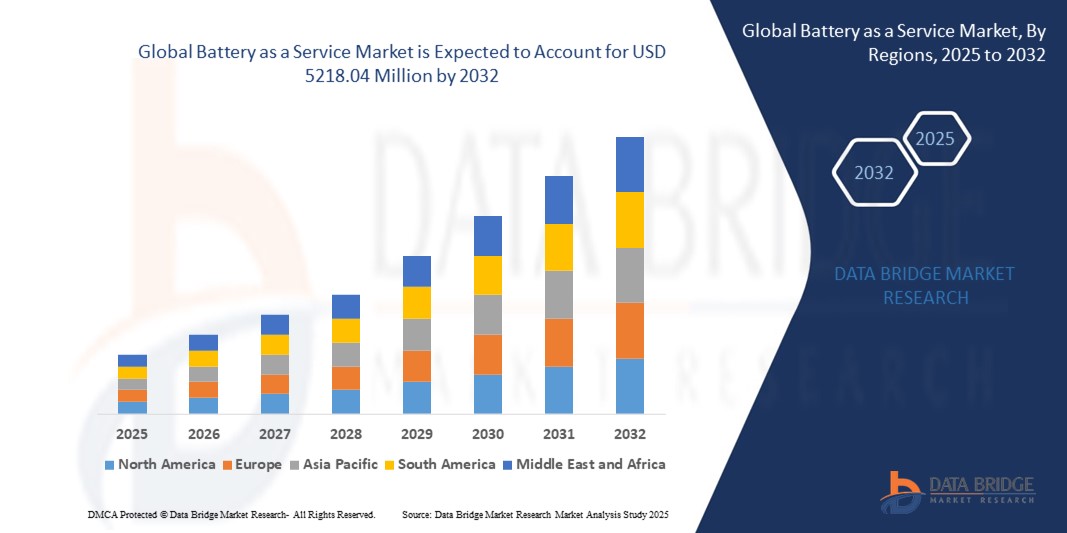
According to Data Bridge Market Research, the size of the global battery as a service market was estimated at USD 750 million in 2024 and is projected to grow at a compound annual growth rate (CAGR) of 27.44% to reach USD 5218.04 million by 2032.
Learn More: https://www.databridgemarketresearch.com/reports/global-battery-as-a-service-market
Conclusion
Battery-as-a-Service represents a fundamental shift in how we think about energy storage. Instead of treating batteries as static assets, we can now view them as dynamic, intelligent services – flexible, reliable, and sustainable. AI is the engine driving this transformation. From predictive maintenance and lifecycle optimization to real-time monitoring and demand forecasting, artificial intelligence ensures that batteries deliver maximum value at minimum cost. Whether for EVs, renewable grids, or industrial applications, the combination of AI and BaaS is set to power the future of clean energy and electrified mobility.